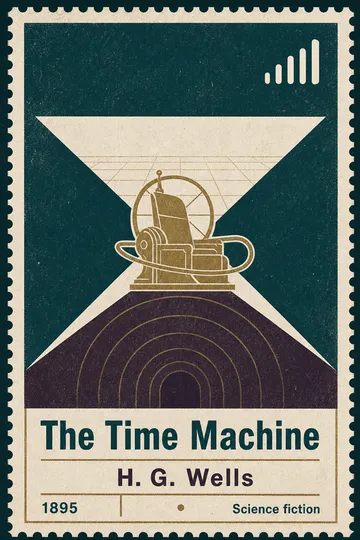
A very interesting and engaging read. I just happened to pick this because it is a short read, but as I read it, I realized that it is very relevant to our time. I already read H. G. Wells before (The Wonderful Visit), and I find myself again admiring just how great a writer he is. It is so easy to imagine what he writes and he describes the setting so beautifully too. Very funny too, like in this scene when he demos the toy time machine to his suspecting guests:
Have a good look at the thing. Look at the table too, and satisfy yourselves there is no trickery. I don’t want to waste this model, and then be told I’m a quack.
I didn’t imagine that the book will engage me so much, because it starts off talking about time as a fourth dimension, and I suspected maybe much of the book will be around that topic, which might be interesting to someone reading in 1895, but not to me. Thankfully, that didn’t turn out to be the case.
Instead, the time traveller travels to year 802,701 A.D. and spends over a week there. The future world and the future people are described in an interesting way. Much of the time is spent theorizing about how humans evolved over hundreds of thousands of years, and theories evolve as the time traveller spends more days there in that time. It is so interesting to read the predictions of someone from that time, especially about the year 802,701 A.D. Again, it is so funny to read how Wells describes the future people Eloi, like in this scene when he tries to learn the language of the Eloi:
At first my efforts met with a stare of surprise or inextinguishable laughter, but presently a fair-haired little creature seemed to grasp my intention and repeated a name. They had to chatter and explain the business at great length to each other, and my first attempts to make the exquisite little sounds of their language caused an immense amount of amusement.
The theories about how humans would have evolved are very interesting, and he reasons them so well too that I got convinced with all of his theories so easily. Overall, the book makes for some very interesting discussions around gender, family, strength, intelligence, social classes, inequalities and many more.
Highlights
Here are some of my highlights from the book.
-
The hype of the time traveller’s narration. The third wall is broken:
He sat back in his chair at first, and spoke like a weary man. Afterwards he got more animated. In writing it down I feel with only too much keenness the inadequacy of pen and ink—and, above all, my own inadequacy—to express its quality. You read, I will suppose, attentively enough; but you cannot see the speaker’s white, sincere face in the bright circle of the little lamp, nor hear the intonation of his voice. You cannot know how his expression followed the turns of his story!
-
The time traveller realizing that the Eloi were fools:
You see I had always anticipated that the people of the year Eight Hundred and Two Thousand odd would be incredibly in front of us in knowledge, art, everything. Then one of them suddenly asked me a question that showed him to be on the intellectual level of one of our five-year-old children—asked me, in fact, if I had come from the sun in a thunderstorm! It let loose the judgment I had suspended upon their clothes, their frail light limbs, and fragile features. A flow of disappointment rushed across my mind. For a moment I felt that I had built the Time Machine in vain.
-
I liked this particular line when the time traveller is theorizing about how the human species split into two - Eloi and Morlocks:
that promotion by intermarriage which at present retards the splitting of our species along lines of social stratification, less and less frequent.
-
How optimizing for safety, security and comfort might have led to the decline of human intelligence:
I grieved to think how brief the dream of the human intellect had been. It had committed suicide. It had set itself steadfastly towards comfort and ease, a balanced society with security and permanency as its watchword, it had attained its hopes—to come to this at last. Once, life and property must have reached almost absolute safety. The rich had been assured of his wealth and comfort, the toiler assured of his life and work. No doubt in that perfect world there had been no unemployed problem, no social question left unsolved. And a great quiet had followed.
-
The narrator’s remark of the white flowers given to the time traveller by Weena:
And I have by me, for my comfort, two strange white flowers—shrivelled now, and brown and flat and brittle—to witness that even when mind and strength had gone, gratitude and a mutual tenderness still lived on in the heart of man.
Words
I have 22 words saved. Here are a few of my favorites:
| # | Word | Definition |
|---|---|---|
| 1 | fecundity | the intellectual productivity of a creative imagination |
| 2 | recondite | incomprehensible to one of ordinary understanding or knowledge |
| 3 | anachronism | something located at a time when it could not have existed or occurred |
| 4 | woolgathering | an idle indulgence in fantasy |
| 5 | desolate | leave someone who needs or counts on you |
| 6 | vestige | an indication that something has been present |
Read it on Kramena